
ODM Jewelry Development When You Only Have a Sketch
A sketch carries intent, not dimensions. That is enough to start an ODM programme, because the first deliverable is not metal — it is a CAD model, delivered in under two working days. The physical sample follows at 25–30 days, and by then the drawing has been through a technical review the buyer can see and correct.
Key takeaways
- CAD is quoted at under 48 hours, so a sketch becomes a reviewable model in about two working days.
- The master sample takes 25–30 days after CAD approval, not after the first sketch.
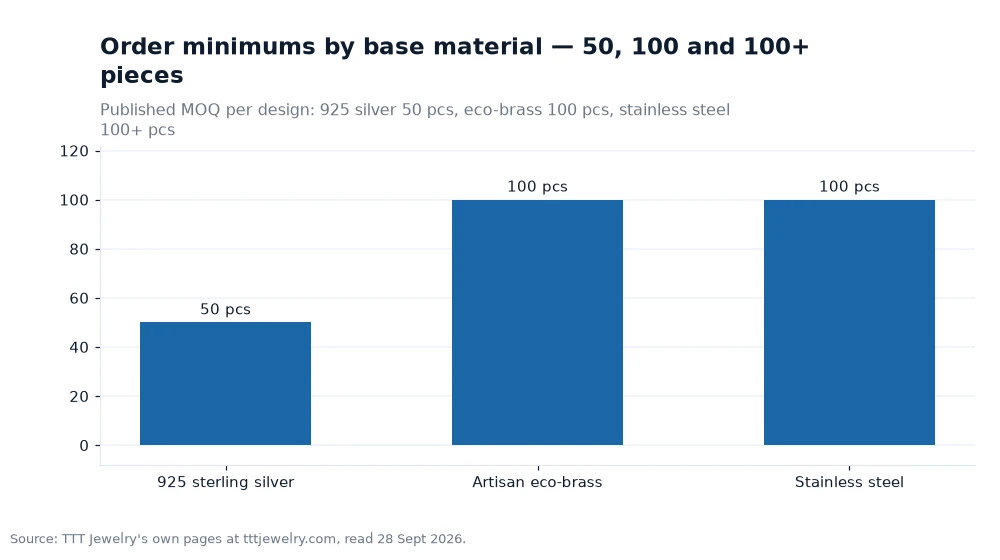
- Minimums are 50 pieces per design in 925 sterling silver, 100 in eco-brass, 100+ in stainless steel.
- A capsule of three silver designs needs 150 pieces in total, against 300 in brass.
What a pencil line can and cannot carry
A sketch shows proportion, mood and where the eye should land. It does not show wall thickness, stone seat depth, clasp clearance or how a curve will feel against a finger. Those are the decisions that turn a drawing into a wearable object, and they are made in CAD rather than on paper.
This is why a rough drawing is a legitimate opening for ODM development under an OEM/ODM programme, and a poor starting point for a purchase order. The factory's design team reads the sketch for intent, proposes a construction, and then shows the buyer a model where thickness and geometry are explicit. The buyer's job at that point is to react to something concrete instead of imagining what the line meant.
The brief that turns a drawing into a model
Three things make a sketch usable. First, scale: a mark on the page saying the pendant is about 22 mm wide, or the ring band about 3 mm thick. Second, placement: where the piece sits on the body, and which face is the front. Third, references: two or three photographs of existing jewelry that show the finish and weight the buyer has in mind.
With those inputs, a custom OEM jewelry factory can move from consultation to 3D CAD in under 48 hours, as TTT Jewelry's published flow does. The model comes back as a render set, and the review is about proportion before ornament. It is much cheaper to move a stone 1.5 mm in a file than to move it in a mould.
Sketches also leave the chain and findings open. A fine cable chain and a heavier box chain change how the same pendant reads, and the clasp choice matters as much as the pendant itself. Mark the chain on the drawing, or accept whichever the factory proposes and review it with the sample. A sketch that shows only the focal piece is a brief with an unfinished sentence in it.
Buyers who already run a custom jewelry wholesale line often have a second advantage: they know which shapes sell in their market. That knowledge belongs in the brief, because a factory can resolve a design but cannot tell a buyer which silhouette their customers will accept.
Choose the base metal before the geometry hardens
Metal choice affects more than cost. Sterling silver takes fine detail and a high polish, which suits delicate stone setting. Eco-brass casts easily and takes multi-layer gold plating, which suits statement shapes and seasonal colour stories. Stainless steel takes PVD vacuum plating and survives showers and swimming, but its hardness limits some fine settings and hand-finishing options.
The minimum order sits alongside those technical differences. At 50 pieces per design, silver carries the smallest commitment of the three. Brass and stainless both start at 100 pieces, so a three-design capsule commits 300 units rather than 150. That arithmetic should be run before the drawing is finalised, not after.
| Base material | MOQ per design | Typical fit for a sketch-led design |
|---|---|---|
| 925 sterling silver | 50 pcs | Fine detail, stone setting, a lower unit commitment per design |
| Artisan eco-brass | 100 pcs | Bold shapes, multi-layer gold plating, seasonal colour ranges |
| Stainless steel | 100+ pcs | PVD finishes, daily wear, pieces expected to meet water |
The sample is the first real review
Renders flatter every design. The master sample, produced 25–30 days after CAD approval, answers questions a screen cannot: how the weight sits, whether the clasp turns easily, whether the plating reads warm or yellow under shop light. It is also the piece that becomes the production reference, so any change after approval costs a new cycle rather than a tweak. Under an ISO 9001:2015 system the inspection is recorded, and the signed sample is the benchmark for plating tone, stone placement and surface finish.
Weigh the sample and wear it for an hour before you judge the finish. A pendant that hangs oddly on a chain, or a ring that rotates because the shank is too light at the base, will not be fixed by plating. Those are construction issues, and they are least expensive to correct while the CAD file is still open.
Prepare the review before the sample lands. Decide who signs off, what the pass criteria are, and which details are negotiable. A sample inspected by five people with five opinions will produce five change requests and a second 25–30 day block. A sample inspected against a written brief produces a decision.
Worked example
A brand wants a three-design capsule from sketches. CAD runs at under 48 hours per drawing, so three designs done one after another take 3 × 48 = 144 hours, or 6 working days. Add the master sample at 25–30 days, and the first metal pieces arrive 6 + 25 = 31 days to 6 + 30 = 36 days after the sketches are accepted.
Now compare the order quantity. In silver, 3 × 50 = 150 pieces covers the capsule. In brass, 3 × 100 = 300 pieces; in stainless steel, 3 × 100 = 300 or more. The silver route commits half the units of the brass route, which is why a sketch-led first collection often starts in silver even when the eventual volume plan is brass. If two drawings are modelled at the same time, the CAD block falls to 48 + 48 = 96 hours, or 4 working days, and the first samples land 29–34 days after the brief.
Frequently asked questions
Can a factory work from a photograph alone?
A photograph is useful as a reference for finish and proportion, but it rarely gives scale. Development still needs an approximate size and a clear statement of which details to keep and which to change.
Do I need to choose the metal before the first CAD file?
It helps. Metal affects wall thickness, setting options and minimum quantity, so deciding early avoids rebuilding a model that cannot be cast in the chosen material.
How close is the sample to the production piece?
The signed master sample sets the standard for the run. Plating tone, stone height and surface finish are matched to that piece, which is why the review deserves care.
Start with the decision, not the drawing
Sketch-led development works when the buyer brings intent and the factory brings construction. The fastest route through the process is a short brief with scale, placement, references and a metal choice, followed by a single approval owner on the buyer's side. A factory that quotes TTT Jewelry timings of 48 hours for CAD and 25–30 days for sampling is describing a sequence that rewards preparation. The purchasing decision, in the end, is about how many units the first drawing is worth — and that number is easier to set before the mould exists.
Source note: figures come from the manufacturer's own website (tttjewelry.com), read 28 Sept 2026.[1]