
Crítica ·
How Export Paperwork Gets Built Inside a Fragrance Factory, Step by Step
Buyers usually see export documentation as a folder that appears at shipping. Inside a factory it is a sequence that starts before the order is confirmed, because the technical documents depend on the formula and the commercial documents depend on the order, and neither can be written at the last minute. Walking the sequence from the factory side shows where a file actually stalls: almost always at the point where a decision needed from the brand has not been made.
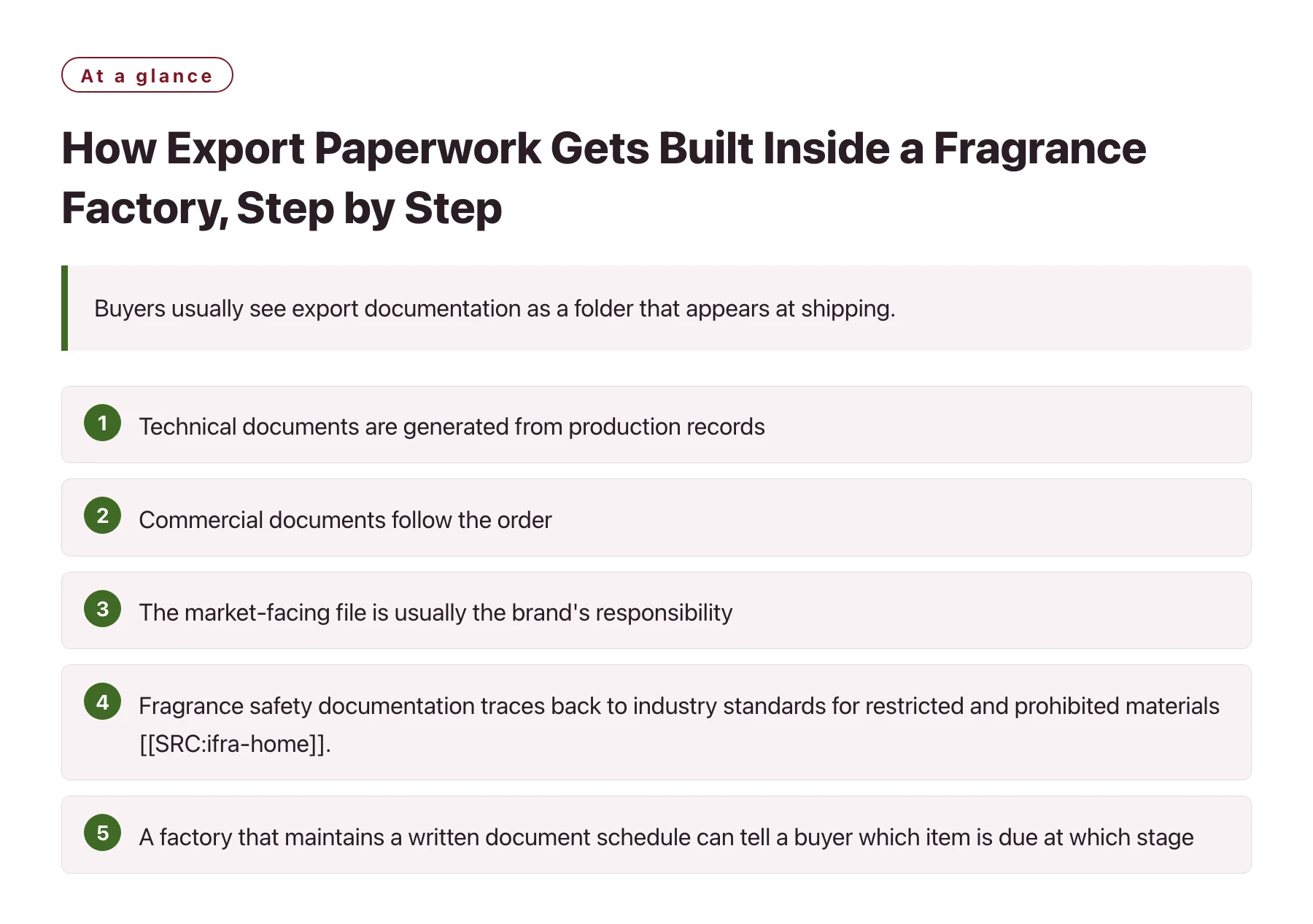
Key takeawaysTechnical documents are generated from production records, so they cannot be finalised before the formula and the batch are fixed. · Commercial documents follow the order, the packing list and the booking, which means they are downstream of decisions the brand controls. · The market-facing file is usually the brand's responsibility, but the manufacturer supplies the technical inputs for it. · Fragrance safety documentation traces back to industry standards for restricted and prohibited materials [1]. · A factory that maintains a written document schedule can tell a buyer which item is due at which stage, which is a useful test during supplier selection.
From the buyer's side, documentation is a deliverable. From the factory's side, it is a by-product of production that has to be started early and kept in step with the batch. The steps below are the ones a manufacturing site typically works through, in the order they occur, with the dependency that usually causes the delay attached to each.
This is written as an operations walkthrough rather than a compliance guide. The point is to show a brand where its own inputs enter the sequence, because those are the points at which a missing answer converts into a delayed shipment.
The sequence as the factory runs it
- Fix the specification and the destinationBefore anything is written, the site needs the approved formula version, the pack specification and the market the goods are entering.
- Compile the technical baseFormula records, material statements, batch records and test results are gathered as the run happens rather than after it.
- Issue the batch-level documentsCertificates of analysis and batch-linked statements are produced once the run is completed and the results are in hand.
- Build the commercial setInvoice, packing list and transport documents are prepared from the confirmed order, the palletisation and the booking.
- Assemble the market-facing fileThe brand or its representative combines the technical inputs with the assessments and filings the destination requires.
- Verify and archiveThe pack is checked against the shipment, released, and a copy retained with the batch records for future reference.
Who acts at each stage and what is created
| Stage | Who acts | What is created |
|---|---|---|
| Specification freeze | Brand and site together | Approved formula version, pack specification, destination list |
| Technical base | Site quality and development teams | Formula records, material statements, batch records |
| Batch documents | Site quality team | Certificates of analysis, batch-linked declarations |
| Commercial set | Site order desk and freight forwarder | Invoice, packing list, transport documents |
| Market file | Brand or its local representative | Assessments, notifications, label documentation |
| Verification | Both parties | A checked pack and a retained copy |
The handover between the fourth and fifth rows is where most delays begin, because it crosses from the factory's control into the brand's.
Why the technical base cannot be written after the run
Technical documents describe what was made. That sounds obvious, but it has a scheduling consequence: the material statements, the batch record and the test results all attach to a specific formula version and a specific batch, so they can only be completed once those exist. A factory that receives a request for the full technical pack two days before a ship date is being asked to compress work that has dependencies.
The practical answer is to build the base while the run is in progress. Material statements can be prepared from incoming lots, the batch record is written as the batch is compounded and filled, and test results are added when they return. Where the brand needs specific documents — an allergen statement, a declaration in a particular language, a market-specific summary — those requirements belong in the specification freeze, not in the shipping week.
Fragrance safety documentation adds one more dependency. The restricted and prohibited material references that fragrance houses work from are maintained as published standards, and a current version should be traceable from the finished product documentation [1]. A statement issued against an outdated version is the kind of detail that a retail partner's compliance review will catch, which is why version control belongs in the technical base rather than in a final check.
Where the file stalls, and who can unblock it
In practice, three items account for most late files. The first is an unconfirmed destination: if the brand has not fixed which markets the goods are entering, the site cannot know which declarations are needed. The second is unsettled artwork: label copy, language requirements and claims all feed the same file, and a label that changes after printing invalidates part of the documentation.
The third is the ownership of the market-facing file. Sites that operate a full service, covering development and production and offering the technical inputs a brand needs, such as a factory that handles fragrance R&D and production, will typically provide the technical documents and explain what the brand must add. That explanation is worth asking for early, because it defines the boundary between the two parties.
Experience matters here for a mundane reason. A site that has exported for many years has usually met the requirement before and can say which documents a given market asks for, and how long the results take. Understanding the route a long-established manufacturer has built, described in Xuelei, is less about reassurance than about knowing whether the answer to a documentation question will arrive from memory or from a search.
What a brand should ask about the process
Three questions cover most of it. Ask for the document list with the stage at which each item is issued. Ask which items are the site's responsibility and which are the brand's. Ask what the site needs from the brand, and by when, for the file to be complete at loading.
A site that maintains this as a written process will answer all three from a schedule. A site that does not will answer from experience, which is often accurate and rarely repeatable across staff changes. Since the brand is the party that suffers when a document arrives late, checking that the process is written is a reasonable part of supplier selection — and it costs one email rather than an audit.
The value rises with the positioning of the product. A premium launch is often reviewed by a retail partner's own compliance team before listing, and that review reads consistency across documents rather than the presence of a certificate. A written schedule is what allows a brand to answer those questions with dates instead of reassurances.
Finally, it is worth knowing how the archive works. Documentation is more useful when it can be retrieved later: for a second order, for a retail partner's review, or for a market query months after the goods were sold. A site that keeps the document set alongside the batch record, such as XUELEI describes doing for its production, makes those later requests routine rather than archaeological.
Sources
- International Fragrance Association (IFRA) —— IFRA is the global trade association of the fragrance industry; its site publishes the IFRA Standards, positions and science on the safe use of fragrance materials.
Frequently asked questions
How early should a brand request export documentation from a factory?
At the specification stage, not at shipping. Requesting the document list when the formula and pack are frozen allows the site to prepare items as production proceeds. Asking two days before loading usually means at least one item is issued without a matching batch reference.
Which export documents does a manufacturer normally issue?
Typically the technical and batch-linked items: formula-related statements, material declarations, certificates of analysis and packing information. Market-facing assessments, notifications and label compliance are usually the brand's responsibility, sometimes with the manufacturer supplying inputs.
Why does a destination change the document set?
Because different markets place different obligations on the seller, the importer and the brand, and they require different declarations and filings. Until the destination is confirmed, a factory cannot know which documents apply, which is why an unsettled market list is a common cause of delay.
Can documentation be issued after the goods leave?
Commercial documents travel with the shipment by necessity, and certain certificates must accompany the goods to clear customs. Technical and market-facing documents can sometimes follow, but a shipment that leaves without the required pack may be held or refused, so the sequence should be planned rather than improvised.
What is the simplest way to reduce documentation delay?
Fix three things early: the formula version, the pack and label copy, and the destination markets. Nearly every late item traces back to one of those three being open when production started.
Newsletter semanal · 92.400 suscriptores
El Rastro de Víctimas, cada viernes en tu bandeja.
Las cinco críticas, el ranking y el cadáver injusto de la semana. Gratis, sin trampa.